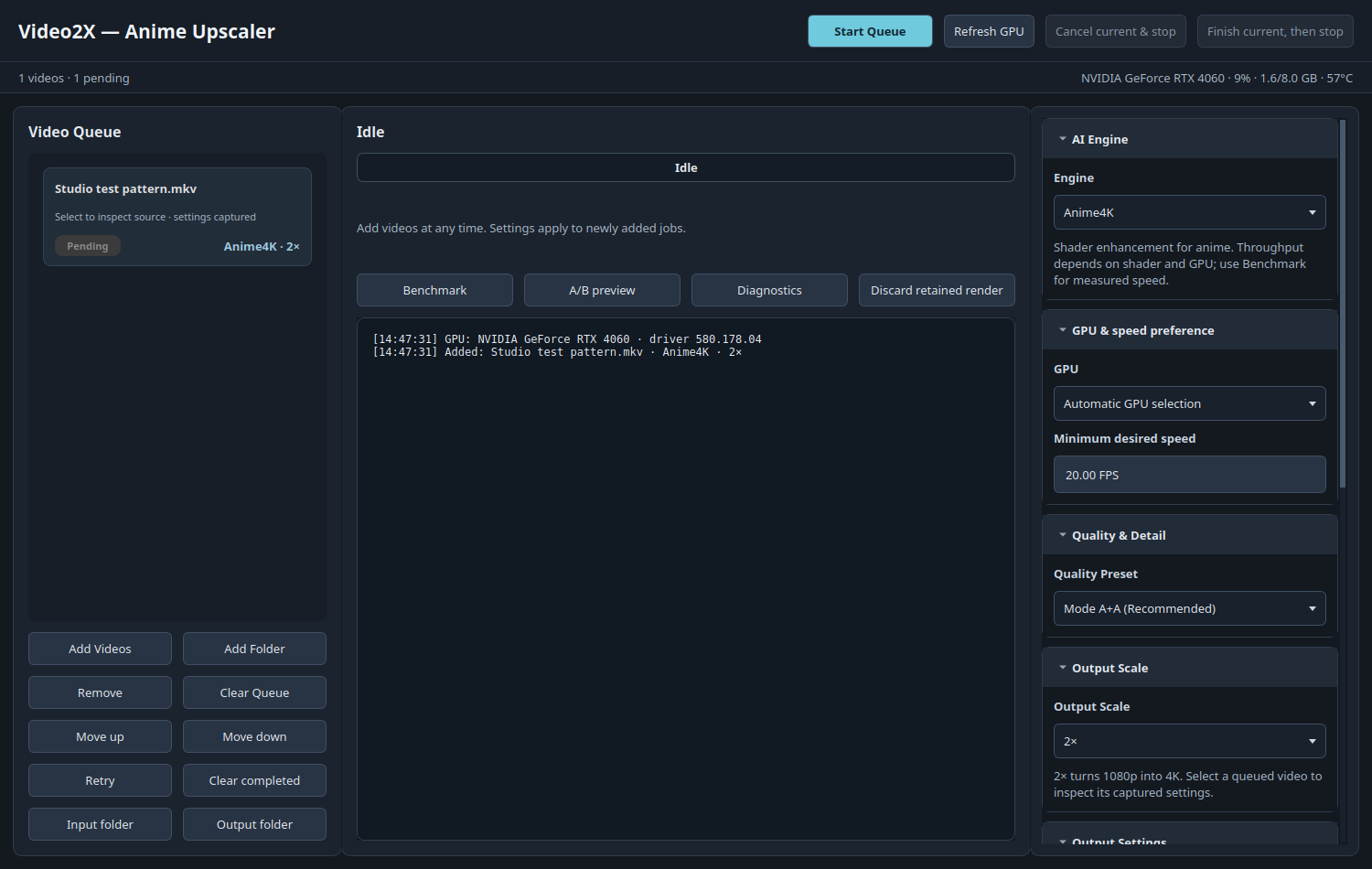
The problem
Long-running GPU jobs need predictable settings, safe cancellation, useful diagnostics, and a way to recover a completed render when a later stage fails.
My contribution
I scoped queue and preservation requirements, directed agent-assisted reliability work, and validated output and failure behavior. Video2X, Anime4K, neural models, FFmpeg, and NVENC provide the underlying processing technology.
Architecture
The Qt view delegates to a queue controller and background worker. Separate modules build commands, track owned subprocesses, store manifests, inspect media, and enforce publication checks. Partial encodes restart; completed-render recovery is a different path.

Read the architecture flow
- 1Captured job settings
- 2GPU identity + capability checks
- 3Existing processing engine
- 4Encode checkpoint
- 5Preserving mux + validation
- 6Separate published output
Never hide a changed processing path
Each queued job captures settings. GPU selection is persisted by UUID and resolved separately for CUDA, NVML, and Vulkan. A capability failure stops work explicitly instead of silently choosing another codec, model, precision, or device. Rendering and finalization are separate so a completed render can survive a later failure.
The tradeoff
This policy favors predictable fidelity and diagnosable failure over automatically finishing every request. Neural providers that use an 8-bit intermediate refuse HDR or high-depth input.
70 existing unit and failure tests pass
The copied-source suite passed on October 21, 2026. It covers settings, color policies, renderer diagnostics, storage ownership, recovery, subprocess handling, and GPU failure logic.
| Existing test cases | 70 passed |
|---|---|
| Settings per job | Immutable snapshot |
| Partial encode recovery | Restart from beginning |
Method and scope
Existing unittest modules executed against private copied source with disposable state and the project interpreter. This is correctness evidence, not a new full-episode throughput or quality comparison.
Verification and limits
Historical engineering reports describe real render, mux, seek, and recovery acceptance. Their performance claims are kept out of the headline until the underlying benchmark chain is fully rechecked.
- No universal minimum FPS, neural reconstruction quality, or compatibility guarantee is claimed.
- Source identity uses bounded content fingerprints; it is not an archival full-source hash.
- Fast production checks are narrower than exhaustive release acceptance.
These results describe the inspected project and stated test conditions. They are not a guarantee for every input or machine.