The problem
Public health sources describe different kinds of signals: advisories, research, trial changes, and quantitative reports. A local interface needs to normalize those differences without suggesting clinical certainty.
My contribution
I directed the source-integration requirements, domain adaptation, and validation workflow. This project shares the local dashboard pattern with Conflict Monitor; it is presented as related work rather than an unrelated architecture.
Architecture
The application reuses a React/FastAPI/SQLite local-service pattern with health-specific fields, parsing, filters, and confidence rules. Separate local ports keep it independent from the Conflict Monitor runtime.

Read the architecture flow
- 1Source-specific adapters
- 2Topic + field extraction
- 3Event matching
- 4SQLite store
- 5FastAPI and confidence rules
- 6React dashboard
Adapt the data contract, preserve uncertainty
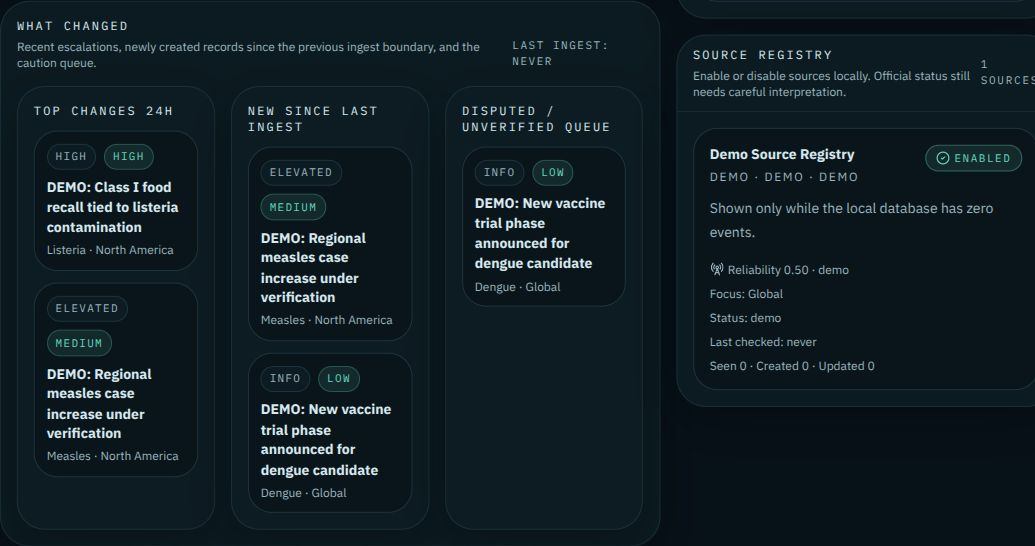
Source-specific adapters normalize topics and quantitative fields before event matching. Rules expose confidence and severity alongside the original source links. The code contains adapters for public feeds, WHO notices, PubMed, and clinical-trial information.
The tradeoff
An adapter in source is not proof that a remote endpoint works today. Heuristic classification is not clinical validation. The public case study keeps those boundaries explicit.
A verified implementation boundary, with clear test gaps
Three existing local tests pass: a manual-event round trip and two scoring scenarios. The source establishes the data flow and adapter structure. No ingestion throughput or medical accuracy measurement is established.
| Existing test cases | 3 passed |
|---|---|
| Shared pattern | Local event dashboard |
| Clinical validation | Not established |
Method and scope
Private copied-source tests with disposable SQLite and configuration. Remote services, live ingestion, and production data were not part of this check.
Verification and limits
The test suite is narrow. Broader fixtures for deduplication, parsing, endpoint failures, and browser flows would improve the evidence.
- This is not a clinical decision support tool or a guarantee of outbreak coverage.
- Confidence values are heuristic, not calibrated probabilities.
- Remote adapter availability and epidemiological sensitivity or specificity remain unverified.
- The configured CARTO basemap required an API key during capture. The screenshot focuses on the actual analytics and source registry.
These results describe the inspected project and stated test conditions. They are not a guarantee for every input or machine.